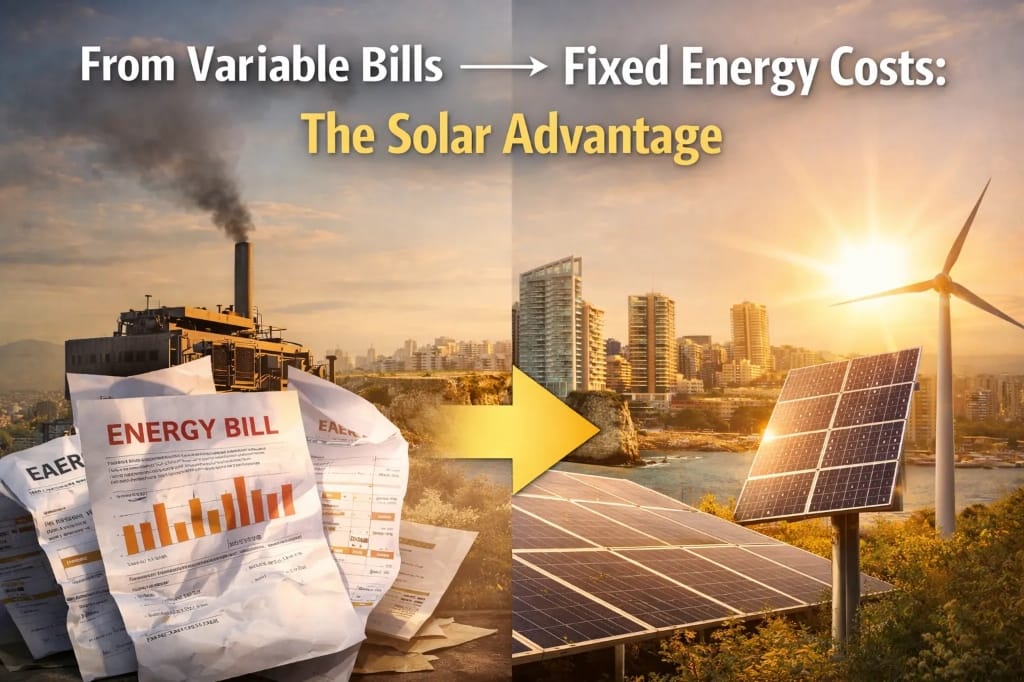
The Hidden Cost of Variable Energy Bills
For businesses operating in Lebanon, energy expenses are no longer just a utility cost. They are a major source of financial uncertainty. Monthly electricity bills fluctuate based on fuel prices, generator availability, currency instability, and supply disruptions.
Most Lebanese companies rely on a combination of limited grid power and diesel generators. While this setup keeps operations running, it introduces constant cost variability.
This volatility makes accurate budgeting and long term planning extremely difficult. For finance and operations teams, it complicates cash flow management and reduces confidence in long term financial forecasts.
- Fuel prices change monthly or weekly
- Hard to predict generator maintenance costs
- Exposure to currency fluctuations
- Spikes during supply shortages
Why Fixed Energy Costs Matter for Businesses
Fixed energy costs create stability. When companies can predict their energy expenses years in advance, they can plan pricing, expansion, and investments with far greater confidence.
Solar energy enables this predictability by replacing variable fuel expenses with a known, long term cost structure.
- Improved budgeting accuracy
- More predictable operating margins
- Reduced exposure to inflation and fuel shocks
- Stronger financial governance
How Solar Converts Variable Bills into Fixed Costs
Solar energy systems require an upfront investment, but once installed, the cost of producing electricity becomes largely fixed.
Ideally, instead of reacting to monthly fuel price changes, businesses lock in a stable cost per kilowatt hour over the life of the system.
- Sunlight is free
- Maintenance costs are low and predictable
- Systems operate for 25+ years
- Energy output can be accurately modeled
Lebanon’s Strong Case for Solar
Lebanon’s geographic location gives it a significant solar advantage. High solar irradiation levels allow commercial systems to generate consistent energy throughout the year.
This makes solar a reliable primary energy source for many commercial and industrial facilities, especially when combined with battery storage.
Solar Versus Diesel from a Cost Perspective
Diesel generators appear flexible, but their lifetime cost is high and unpredictable. Diesel based energy involves continuous fuel purchases, rising maintenance, and environmental liabilities.
Solar systems, while capital intensive upfront, offer significantly lower lifetime costs. Over 15 to 20 years, the cost per kilowatt hour from solar is often far below diesel generation.
- Diesel: Continuous fuel purchases
- Diesel: Rising maintenance & replacement costs
- Solar: Lower lifetime costs
- Solar: Cheaper per kWh over time
Fixed Costs Through Solar Power Purchase Agreements
Not all companies want to invest capital upfront. Solar power purchase agreements provide an alternative path to fixed energy costs.
Under a PPA, a third party installs and operates the system, and the business buys electricity at a fixed rate. Contracts typically last 10 to 20 years.
This model converts variable generator expenses into a predictable monthly energy cost with no initial investment.
Beyond Cost Stability
The solar advantage extends beyond fixed pricing. Additional benefits include reduced operational downtime, improved sustainability, and lower exposure to future fuel regulations.
For Lebanese companies working with international partners, predictable and cleaner energy sources are increasingly a commercial requirement.
- Reduced operational downtime
- Improved sustainability & ESG
- Lower exposure to fuel regulations
- Greater energy independence
Turning Energy into a Strategic Asset
Solar allows companies to transform energy from a volatile expense into a controllable asset. Fixed energy costs improve decision making, protect margins, and support long term growth.
In a market defined by uncertainty, stability becomes a competitive advantage. Solar provides that stability.