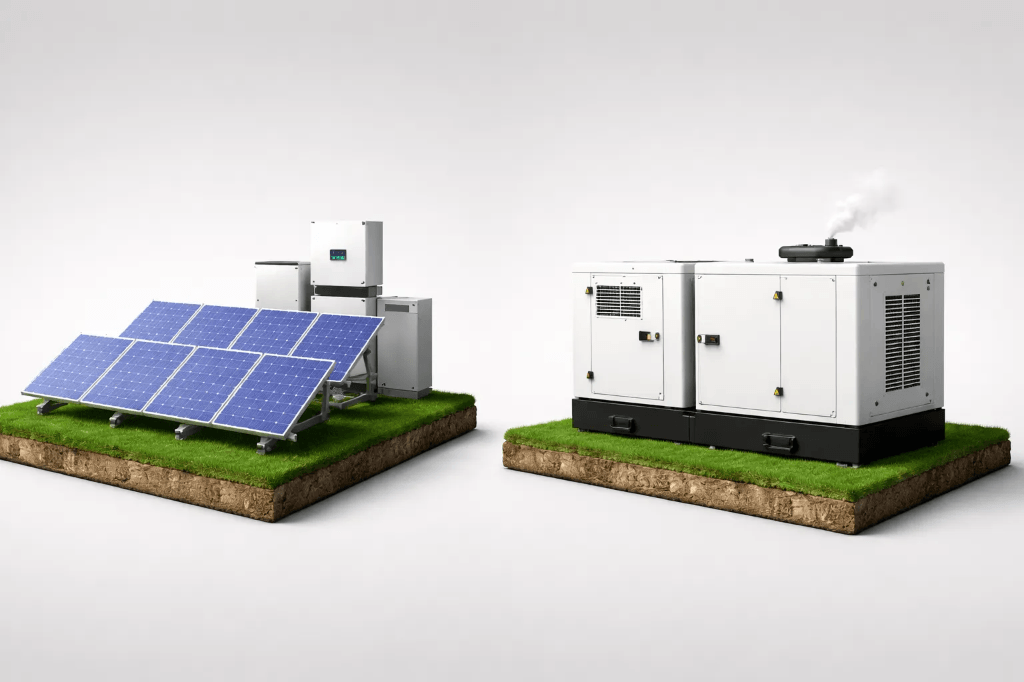
The Critical Question for Lebanese Businesses
For decades, Lebanese businesses have relied on diesel generators as a necessary evil—an expensive workaround for an unstable grid. Today, rising fuel costs, supply uncertainty, and increasing operational pressure are forcing business owners to ask a critical question:
Is it still financially viable to rely on generators, or has solar become the smarter long-term investment?
This article provides a clear, realistic cost comparison between solar energy systems and diesel generators for Lebanese businesses, based on real operating conditions—not theoretical models.
The Reality of Power in Lebanon (2026)
Lebanon's electricity landscape is unique—and unforgiving. Grid supply averages 0–4 hours per day in most regions. Diesel generators have become the primary power source, not backup. Fuel prices remain volatile and unpredictable. Equipment wear is accelerated due to constant use.
For businesses, electricity is no longer an operating expense—it's a strategic risk.
- Grid supply: 0–4 hours/day (in most regions)
- Diesel generators: Primary power source, not backup
- Fuel prices: Volatile and unpredictable
- Equipment wear: Accelerated due to constant use
Option 1: Diesel Generators – The True Cost
At first glance, generators appear affordable with upfront costs ranging from $10,000–$20,000 for 50–100 kVA units, $25,000–$50,000 for 150–300 kVA, and $70,000+ for 500+ kVA systems. But capital cost is only the beginning.
Fuel Costs – The Silent Killer
Consider a medium-sized commercial business consuming ~150 kVA: diesel consumption runs 30–35 liters per hour, with average runtime of 16–20 hours per day. Monthly diesel cost reaches $6,000–$10,000+, translating to annual fuel cost of $70,000–$120,000.
And this assumes stable diesel supply, no black-market pricing spikes, and no logistics delays. Fuel is 100% recurring—forever.
- Diesel consumption: ~30–35 liters/hour
- Average runtime: 16–20 hours/day
- Monthly diesel cost: $6,000 – $10,000+
- Annual fuel cost: $70,000 – $120,000
Maintenance & Downtime
Generators in Lebanon run far beyond their intended duty cycle. Typical annual costs include $2,000–$5,000 for oil and filters, $3,000–$8,000 for major servicing and parts, plus unpredictable costs from unexpected breakdowns.
The hidden cost is downtime. One generator failure can mean lost production, missed deadlines, damaged equipment, and reputational risk.
5-Year Generator Cost Summary (Mid-Sized Business): Generator CAPEX $30,000 + Diesel Fuel $400,000–$550,000 + Maintenance $40,000–$60,000 = Total $470,000–$640,000
Option 2: Solar Energy – The Long-Term Asset
Solar is no longer a 'green experiment' in Lebanon—it is a financial instrument.
For a commercial hybrid solar system (100–200 kWp), the upfront investment includes Tier-1 solar panels with 25-year lifespan, hybrid inverters and control systems, optional scalable battery storage, plus engineering, installation, and commissioning. Typical CAPEX ranges from $80,000–$150,000 depending on storage and complexity.
Solar Operating Costs (Near-Zero)
Solar systems require no fuel, minimal maintenance, deliver predictable output, and include remote monitoring. Annual OPEX is limited to $1,000–$2,000 for cleaning and inspections, with minimal inverter servicing long-term.
Lebanon is ideal for solar with high solar irradiance, long daylight hours, and peak production that aligns with business hours. Well-designed systems can cover 60–90% of daily energy demand—even more when paired with smart load management.
5-Year Solar Cost Summary: Solar CAPEX $120,000 + Operating & Maintenance $8,000–$12,000 = Total ~$130,000
Solar + Generator Hybrid: The Smart Middle Ground
For most Lebanese businesses, the optimal solution is not 'solar OR generator' but 'solar FIRST, generator LAST.'
A hybrid system delivers: solar covers daytime load, batteries handle transitions and peaks, generator runs only when necessary. This reduces fuel consumption by 60–85%, dramatically extending generator lifespan, cutting diesel costs, stabilizing operations, and improving ROI.
- Solar covers daytime load
- Batteries handle transitions & peaks
- Generator runs only when necessary
- Fuel consumption reduced by 60–85%
ROI & Payback: The Numbers That Matter
Typical payback periods are 2.5–4 years for solar-only systems and just 18–30 months for solar + generator hybrid setups.
After payback, energy becomes a competitive advantage. Costs are fixed and predictable. Cash flow improves immediately.
- Solar-only payback: 2.5 – 4 years
- Solar + generator hybrid payback: 18 – 30 months
- After payback: energy becomes a competitive advantage
Beyond Cost: Strategic Business Benefits
Solar offers advantages generators never will: price stability with no fuel exposure, energy independence, reduced operational risk, better ESG and sustainability positioning, higher asset value, and a quieter, cleaner work environment.
For industrial and export-oriented businesses, these are no longer optional—they are expected.
- Price stability (no fuel exposure)
- Energy independence
- Reduced operational risk
- Better ESG & sustainability positioning
- Higher asset value
- Quieter, cleaner work environment
Final Verdict: Which Makes Sense in Lebanon?
When comparing generators vs solar: generators have lower upfront cost but extremely high long-term cost, 100% fuel dependency, poor predictability, negative ROI, and serve as a short-term fix. Solar has higher upfront cost but low long-term cost, 0% fuel dependency, excellent predictability, strong ROI, and serves as a long-term asset.
Generators keep you running. Solar keeps you competitive.
The Smart Move for Lebanese Businesses
In Lebanon's energy reality, solar is not a luxury—it is financial discipline.
Businesses that delay the transition lock themselves into rising costs, accept unnecessary operational risk, and lose long-term competitiveness. Those who act now control their energy future, protect margins, and build resilience into their operations.
A proper decision starts with data, not assumptions. Get a customized energy cost analysis and ROI projection designed specifically for Lebanon's operating conditions.